Cutting through the board noise
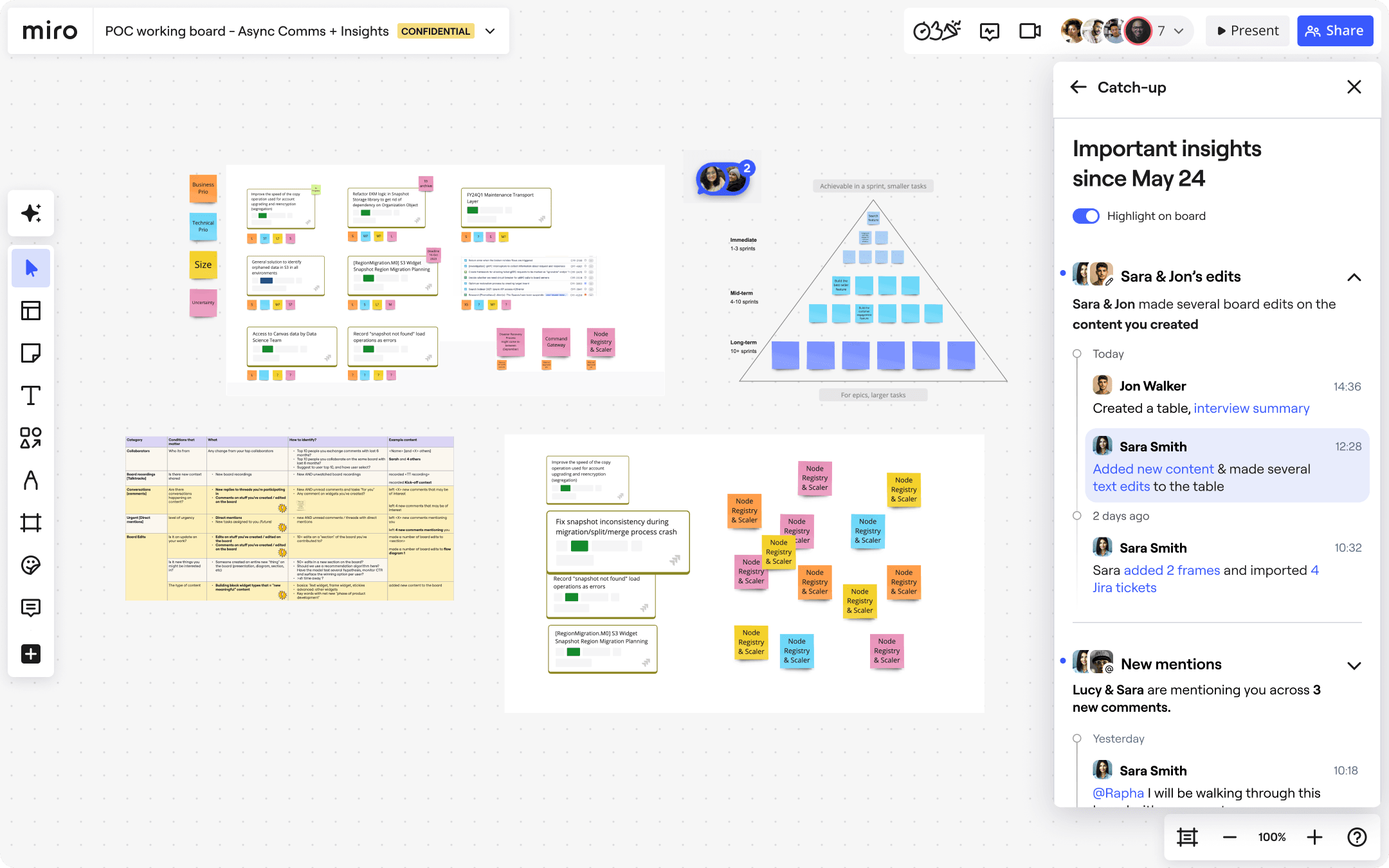
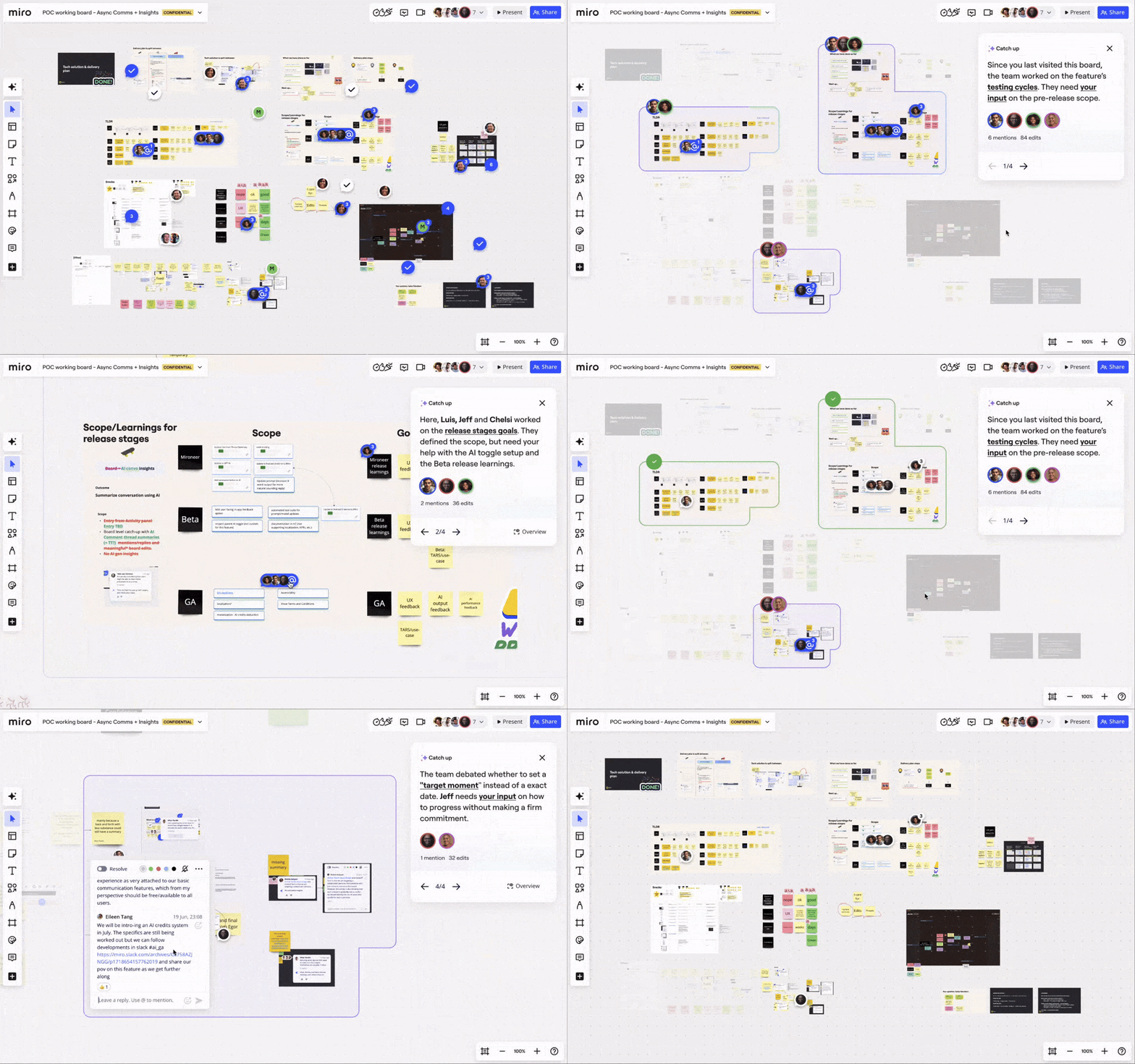
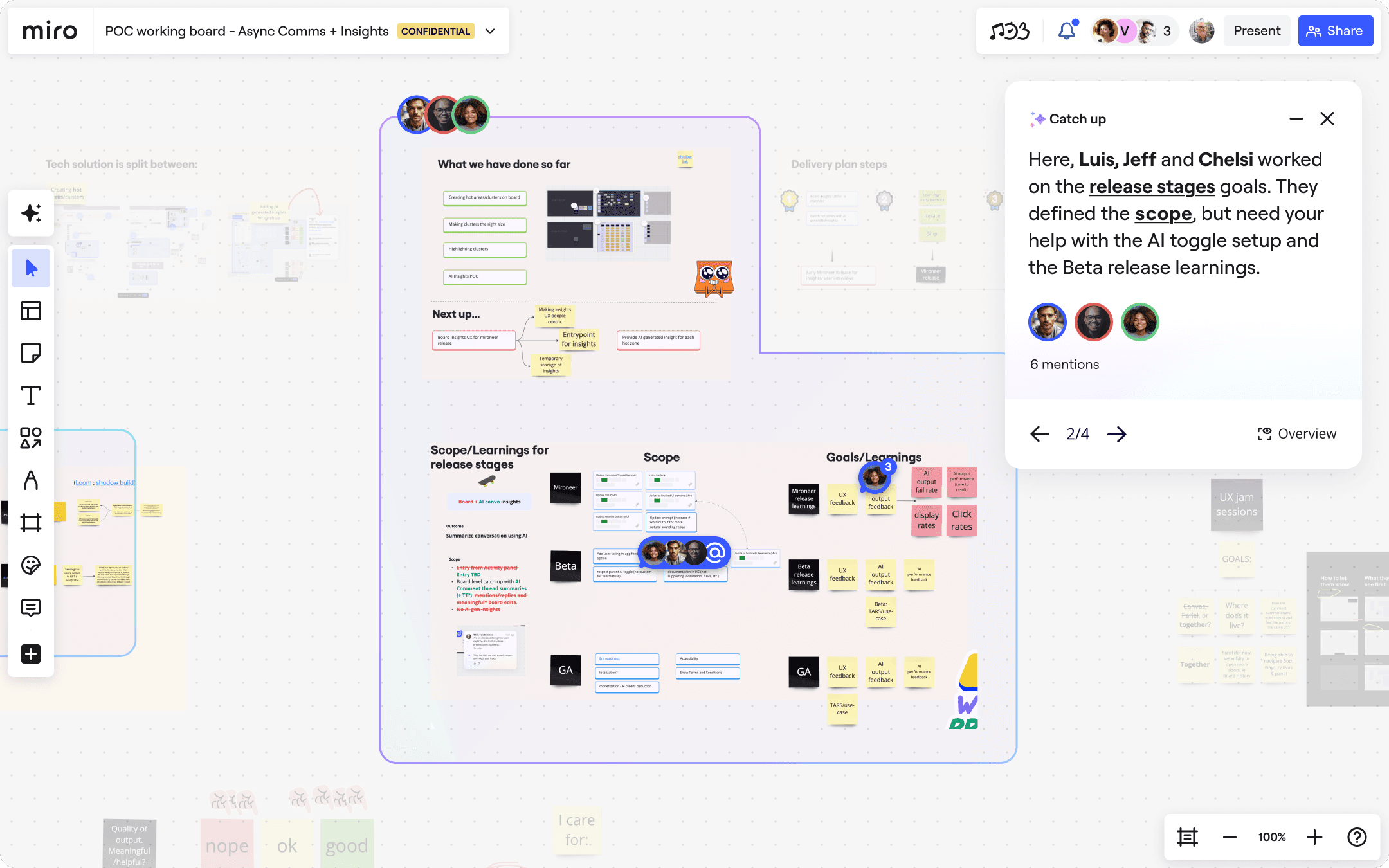
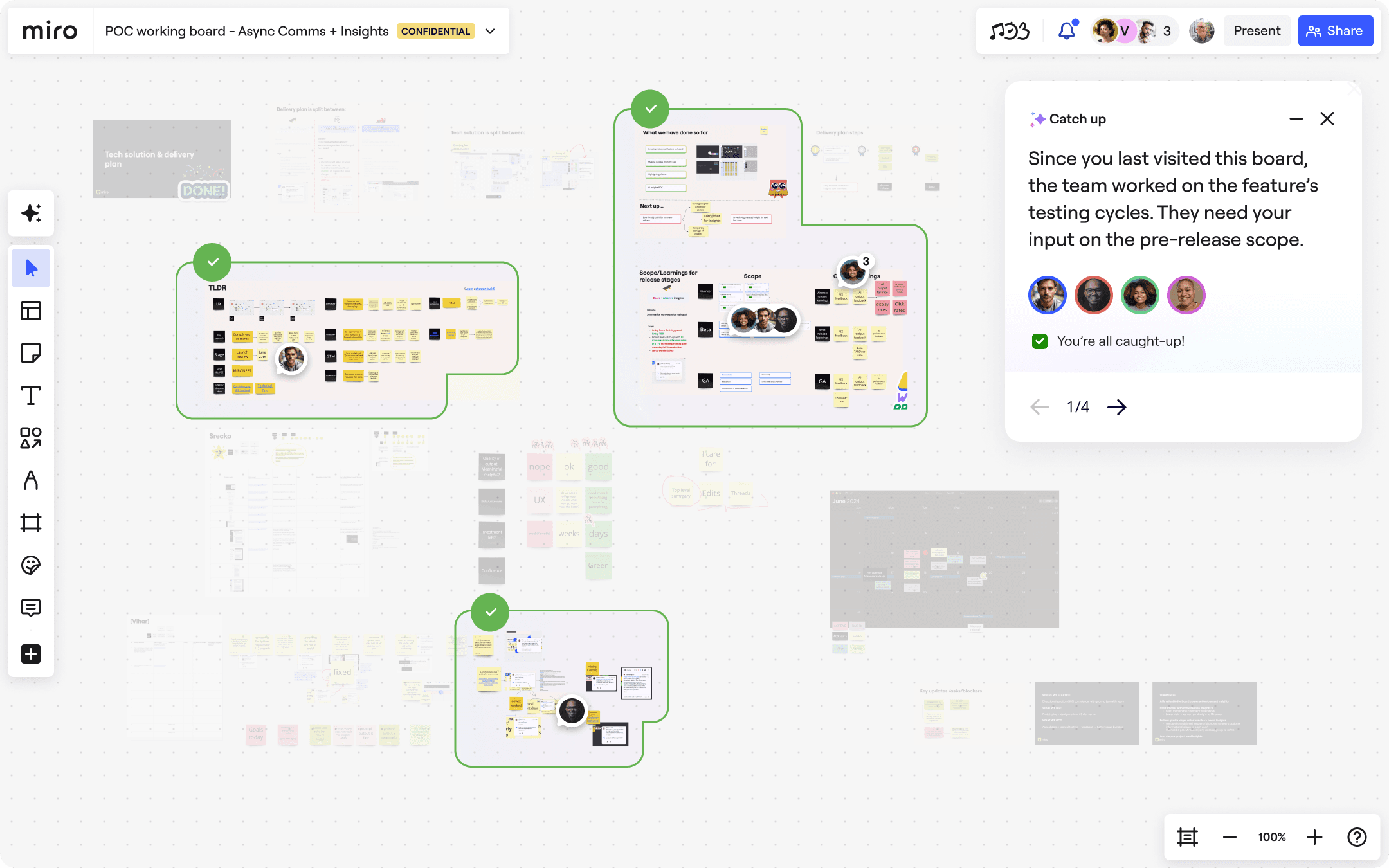
Come back to a busy Miro board after some time away and it feels overwhelming—so many updates and comments to sift through. Instead of manually sorting through the noise, Catch Up automatically clusters key areas of interest and provides an intuitive AI-driven summary, visually highlighting what's changed, who's been involved, and where your attention is needed. This lets you quickly catch up and focus on what matters most.
Realigning for impact
After Talktrack's success, our team encountered an unexpected roadblock. Leadership changes and shifting company priorities left us struggling to see a clear way forward. The team felt stuck, and we needed a pivot. After all, we weren't just a “Talktrack” team; we were an async collaboration team.
In parallel, Miro was undergoing a major strategic shift toward Intelligent Canvas—an initiative aimed at enhancing the board experience with AI-driven features. It was an opportunity to position our team around a collaboration problem that genuinely needed AI.
We realized that if we were to continue making an impact, we needed to refocus, realign, and reignite our momentum.
- Get signal
- Get context
- Get in flow
- Get feedback
The story begins: defining our focus
The product trio—PM, EM, and me—took the initiative to kick off ideation sessions, aiming to cut through the ambiguity and define our next steps clearly and quickly.
We returned to our async-loop framework: Get Signal → Get Context → Get in Flow → Get Feedback. Talktrack had proven effective in the last two steps. We focused on Get Signal, realizing that while Talktrack addressed steps two and four, we needed something to help users identify where to start and what matters most.
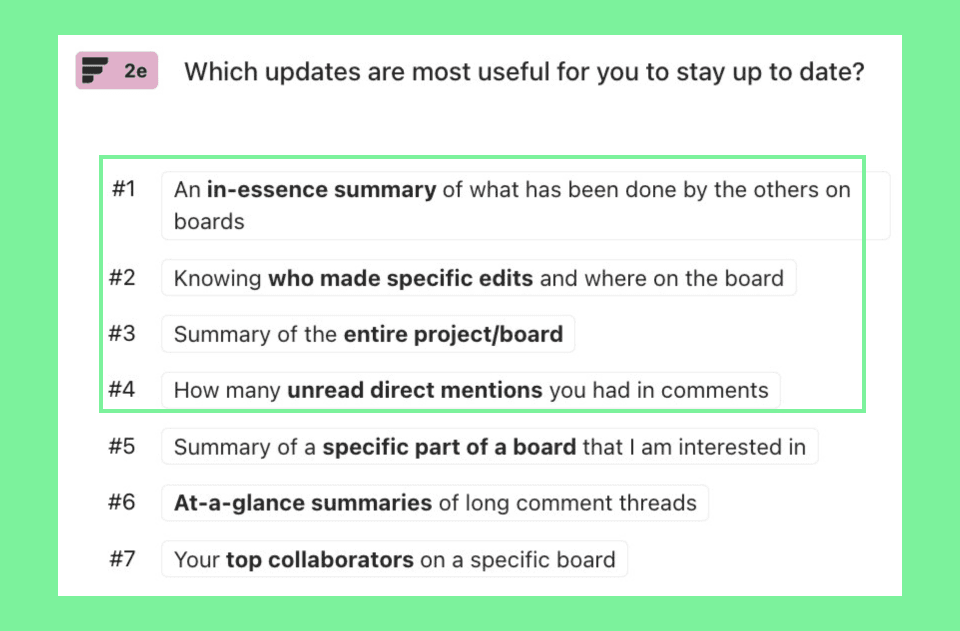
Existing research from our team and elsewhere at Miro, followed by a large-scale survey, confirmed the pattern: people were overwhelmed by the volume of updates and unable to locate what mattered.
Delivering immediate user value for greater impact: Comments Summary
Catch Up was a big feature and the team had little credibility to spend after drifting for a quarter. We made a sequencing call: build something smaller that solved the same problem at a tighter scale, ship it quickly, and use it to earn room for the larger idea.
That became Comments Summary—click summarize on a long comment thread and get the key points. I worked with the AI and Conversation teams on both the UX and the model behaviour, testing summaries, finding where they were confidently wrong, and reshaping the input and output until the result was useful.
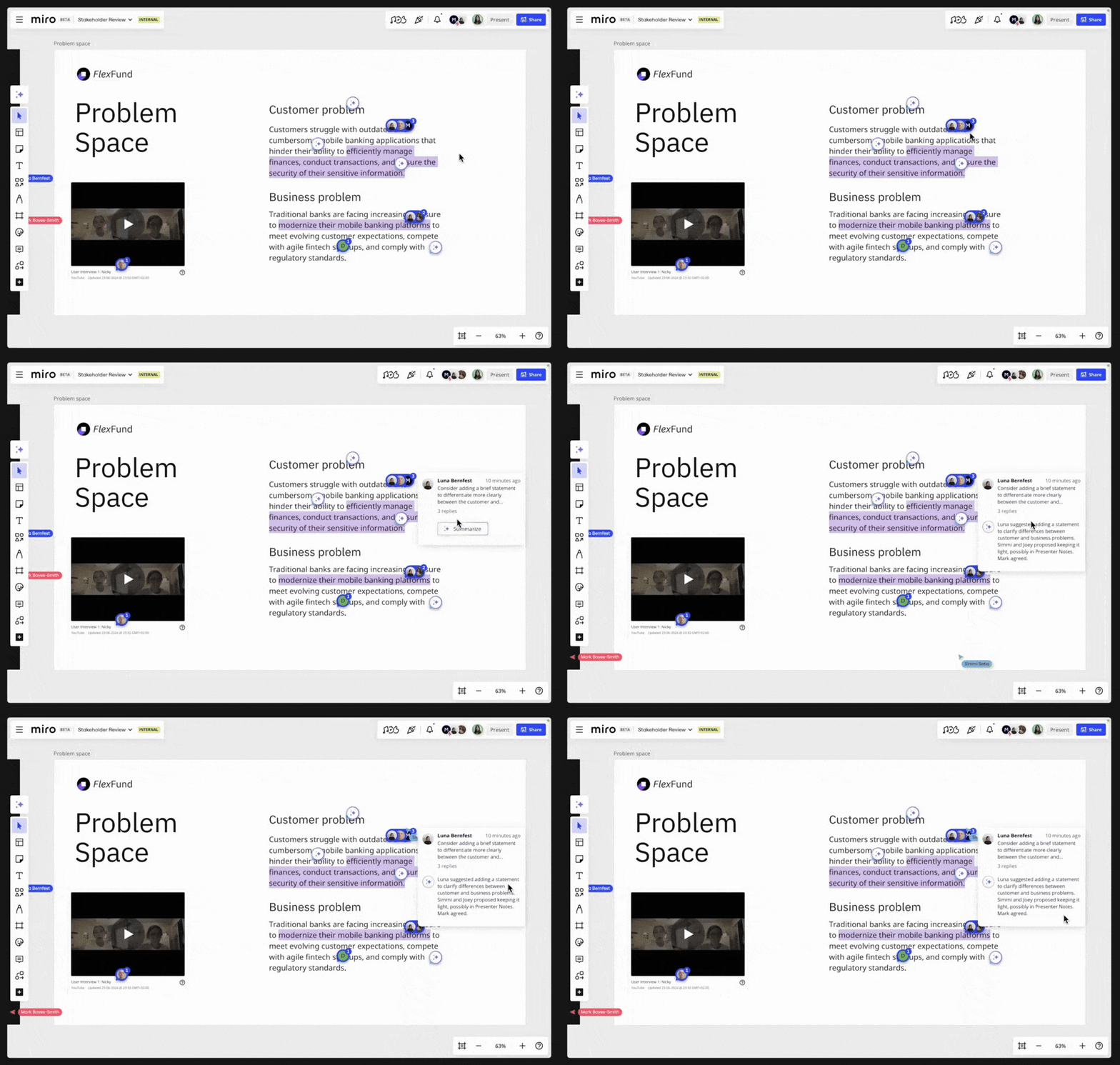
Once we had a working prototype, I pitched it to our head of design. Her reaction—“This is actually working already”—gave us the green light. Comments Summary shipped to customers and, just as importantly, bought us the standing to build Catch Up.
Too many cooks in the kitchen
With research done, Comments Summary shipped, and alignment on Catch Up's direction, I started the UX with my design manager and the Conversation team designer while my PM led the initiative.
It got slow. Too many voices, conflicting feedback from adjacent teams, scope creeping, and a design that became more rigid each time someone new touched it. The solution was inflexible and the craft wasn't at Miro's standard. Design review made that impossible to ignore.
Fewer voices, sharper progress: aligning, refining, delivering
My PM and I brought the work back to the smaller team, and I took design leadership of the project. Fewer people meant faster decisions and clear accountability. I ran open design jams to rebuild the goals and UX vision around something the team genuinely believed.
Once the scope and core UX were clear, the engineers ran a technical spike because the model was central to whether any of it worked. We tested and refined prompts until summaries were accurate enough that a person could rely on them without going back to check every change.
The biggest design decision was dropping the panel. In the original approach, a person read a summary, found the change on the board, and then mapped one onto the other—every time. We instead used the board itself to show what happened. The summary points at the thing it describes, so the translation step disappears.
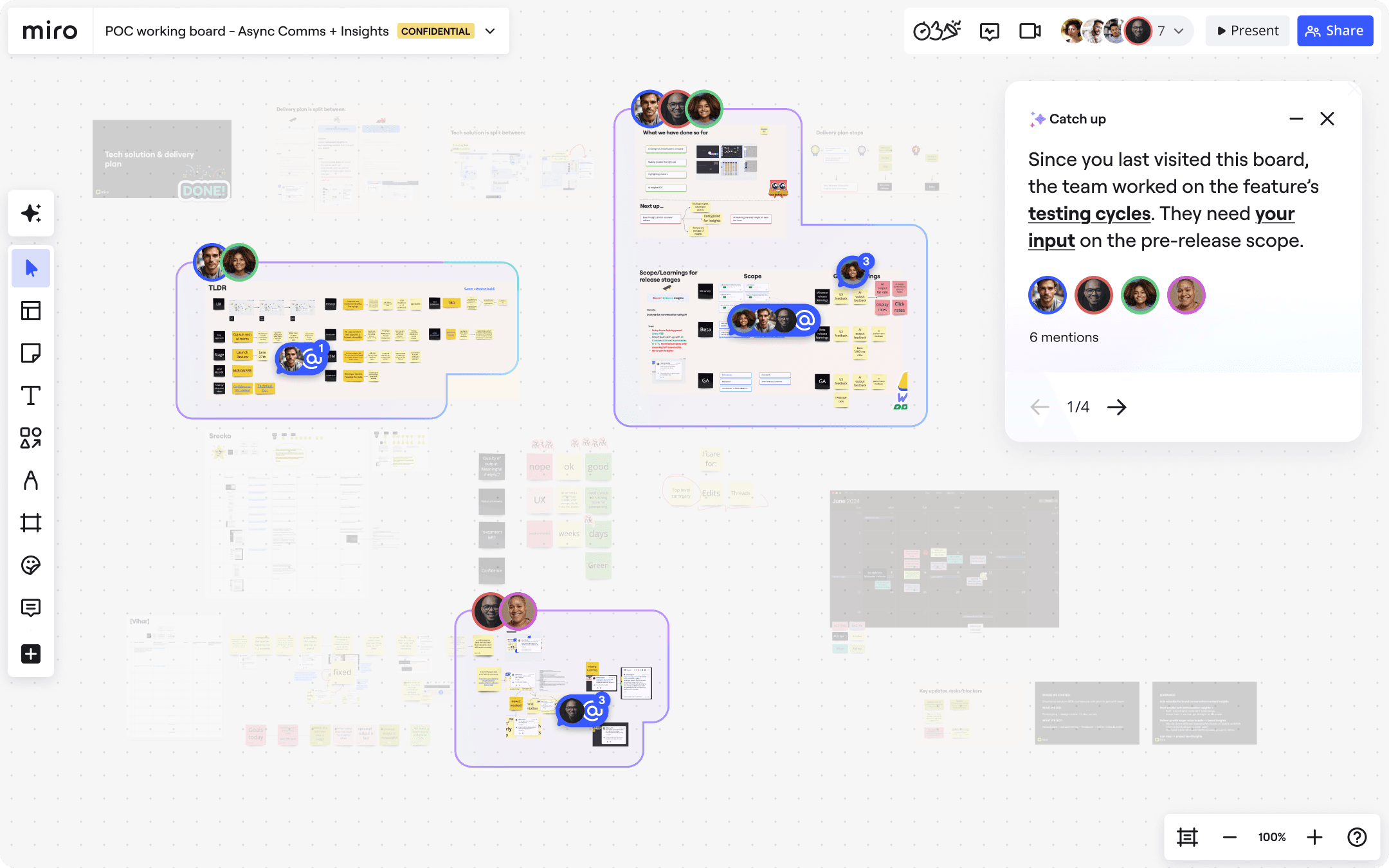
I deliberately over-communicated with stakeholders and leadership. The project had already lost trust once, and the cheapest way to protect it was to make sure nobody was surprised. I ran critiques, presented alternatives, and took the refined UX to design and solution review with my PM.
Approved. MVP go-ahead.
Catch Up catches up—and steals the spotlight
- 300%
- Month-over-month growth
Leadership demoed the Catch Up MVP as part of the Intelligent Canvas presentation in New York. It was not yet a full launch, but it landed. Catch Up was one of the most commented-on features in the presentation—and notably, people commented on the interface. For a feature whose entire job is making a mess legible, that was the review we wanted.
Looking back, looking forward
Sequencing is a design decision. Shipping Comments Summary first was not a compromise; it was the thing that made Catch Up possible. Getting something working in front of a decision-maker beat arguing for the bigger version.
I waited too long to take control. I knew the design was rigid and the craft was off before the review told me. Acting two weeks earlier would have cost nothing.
Fewer people can make better decisions. Broad input made the work worse, not better. Pulling it back to a small, accountable team was the turn.
With AI features, the model is the material. Prompt quality and output handling determined whether the feature was trustworthy. That is a design surface, not an engineering detail.